Collection Digital
Original Concept – UI Design – Frontend Development
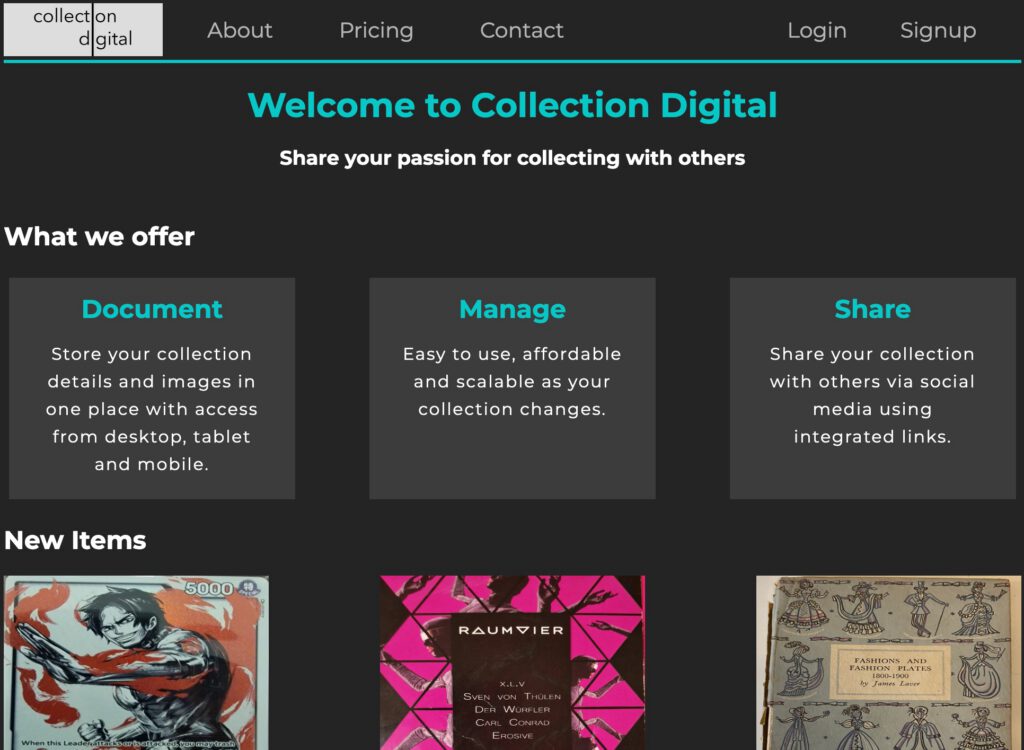
This project began as my own idea. Working as a collection assistant for small museums and individual collectors in London, I saw firsthand that most were documenting collections in Excel, Word, or a notebook and used a tedious process to share the collection on social media. I wrote the brief for a web application to store collection items and with social media sharing built in, designed the initial wireframes during a UI course, then brought the concept into a full stack development course to build it.
Origin
- Personal Concept
- UI Design coursework
- Web Dev coursework
My Role
- Concept + Brief
- UI Wireframes
- Frontend Dev
Stack
- React 18 + Vite
- React Router v6
- MUI Bootstrap
Team
- 3 Developers
- 4 Weeks
The Problem
A real gap, observed firsthand
During my time working as a collection assistant for small museums and individual collectors in London, I noticed that most were documenting their collections using everyday tools that weren’t built for the job. The professional alternatives were designed for large institutions with complex requirements and large budgets — leaving individual collectors and small museums without a practical option.
- Most collectors used Excel, Word, or a handwritten notebook to document objects
- Images were stored in separate files with no connection to the object record
- Professional collection management software is built for large museums — complex features and large price tags
- No simple way to share collections publicly or on social media
The goal: collection software that is easy to use and affordable, designed for individuals and small museums, with social sharing built in from the start.
Project history
From idea to build
London
Worked as a collection assistant — observed the documentation problem firsthand across multiple small museums and private collectors
UI Design Course
Began the project during UI Design training — defined the problem, wrote the brief, produced the initial wireframes and visual style. The project was not completed at this stage
Full Stack Dev Course 2023
Brought the concept into the full stack development course as the group project. Presented the brief to the team, using the V&A’s public API as the collection data source
Built
Frontend built in React 18 with Vite — 341 commits across 3 contributors. I owned the frontend throughout, from project setup through to V&A API integration
Design
Initial wireframes — from the UI Design course
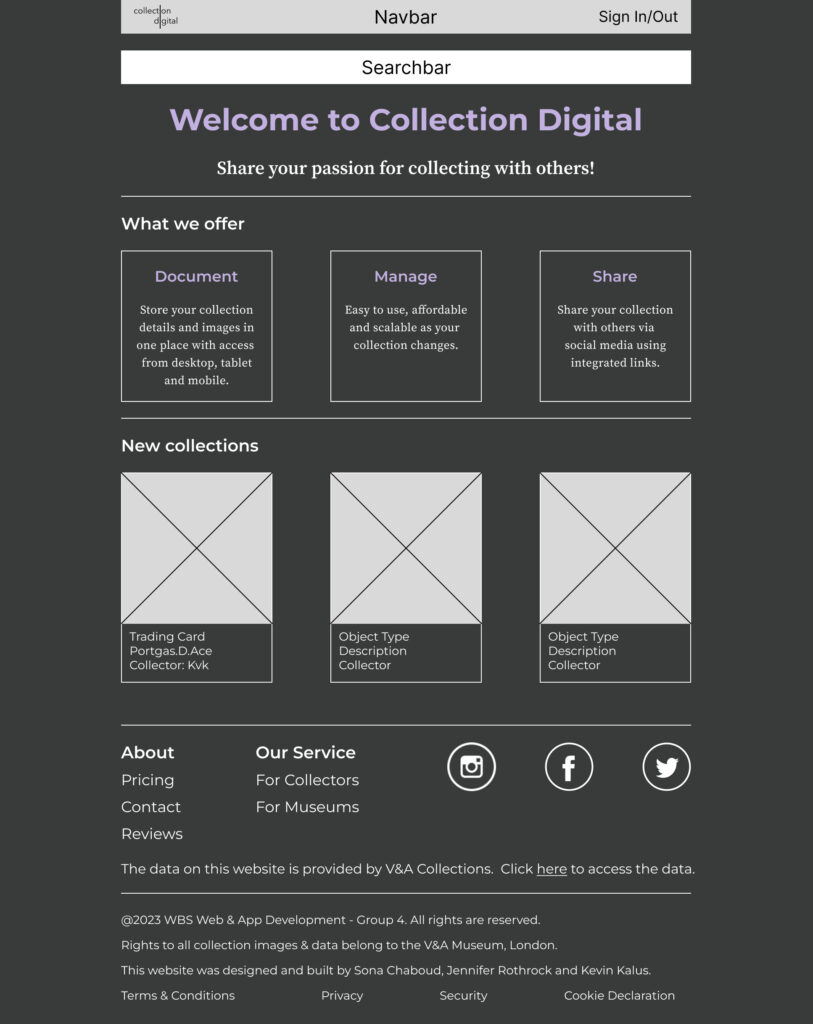
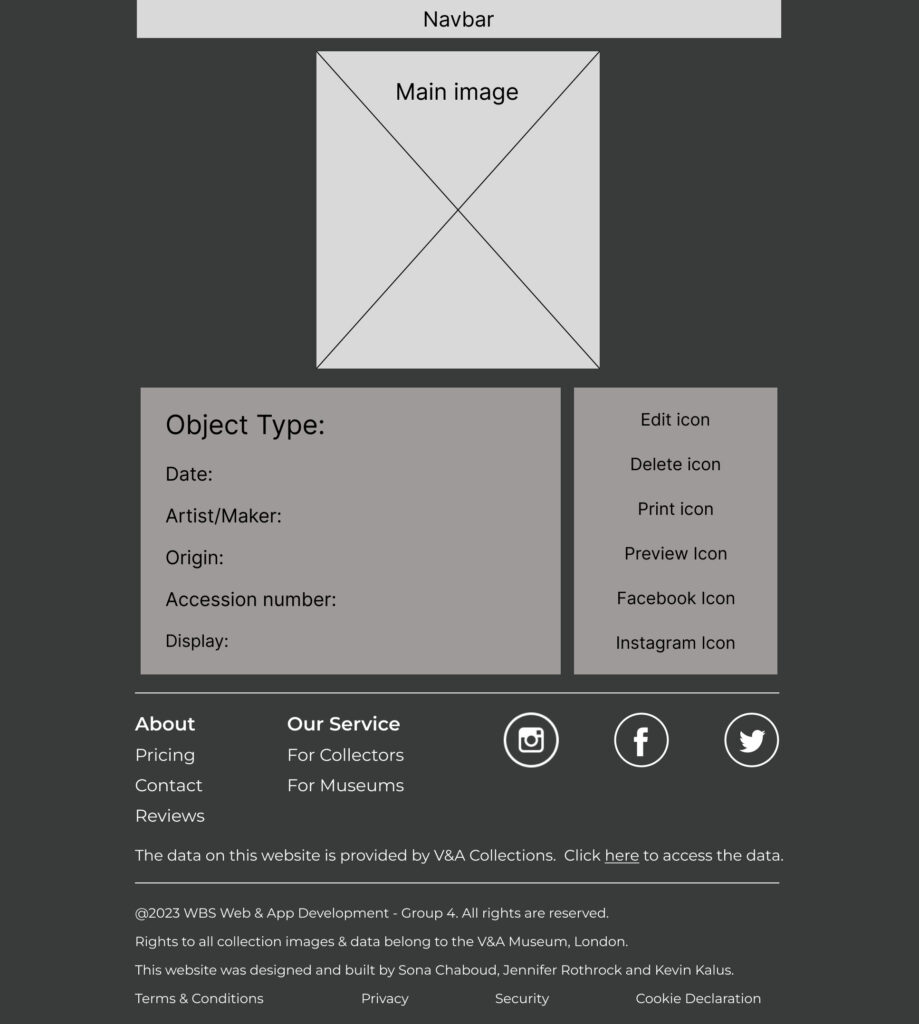
Original wireframes produced during the UI Design course — dashboard, search results, and individual item page
The wireframes defined the core structure before any code was written — a dashboard showing recent items with filter sidebar, a search results grid, and an individual item page showing the main image alongside structured object metadata. These layouts informed the React component structure built in the development course.
The V&A API
Why the Victoria and Albert Museum
The Victoria and Albert Museum in London provides free public access to its collection data via API. I chose it specifically, not as a random free API but because I know the institution from living and working in London. The V&A’s collection spans fashion, textiles, ceramics, furniture and design across cultures and centuries — a rich and varied dataset that reflects the kind of collection a real collector or small museum might hold.
The API returns structured object records including system numbers, object types, dates, artist/maker names, primary place of origin, accession numbers, and IIIF image URLs — all the fields a collection management tool needs.
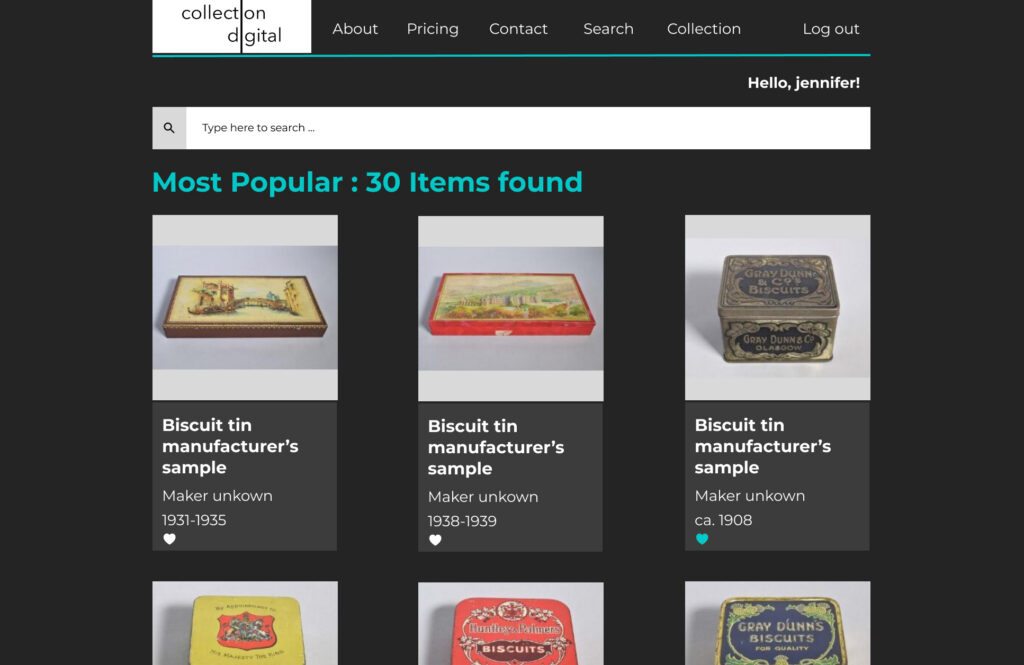
V&A collection data rendered in the application
My Contribution
What I brought and what I built
Across the full project — from concept to code
- Originated the concept — identified the real-world problem from museum work in London, wrote the project brief, and defined the MVP scope
- Produced the initial wireframes during the UI Design course — dashboard, search results, and item detail page layouts that informed the final build
- Set up the Vite and React 18 project foundation, configured ESLint for the team, and established the folder and component structure
- Built the V&A item detail page — useParams routing, IIIF image rendering, structured metadata with graceful fallbacks for missing fields
- Wrote component-scoped CSS with mobile and tablet breakpoints throughout
- Integrated the frontend with the backend REST API — Axios, loading states, error handling, JWT authentication flow
- Managed the frontend GitHub branch — 341 commits, pull request review, merge conflict resolution
Code Sample
SearchResultsItem — component and CSS
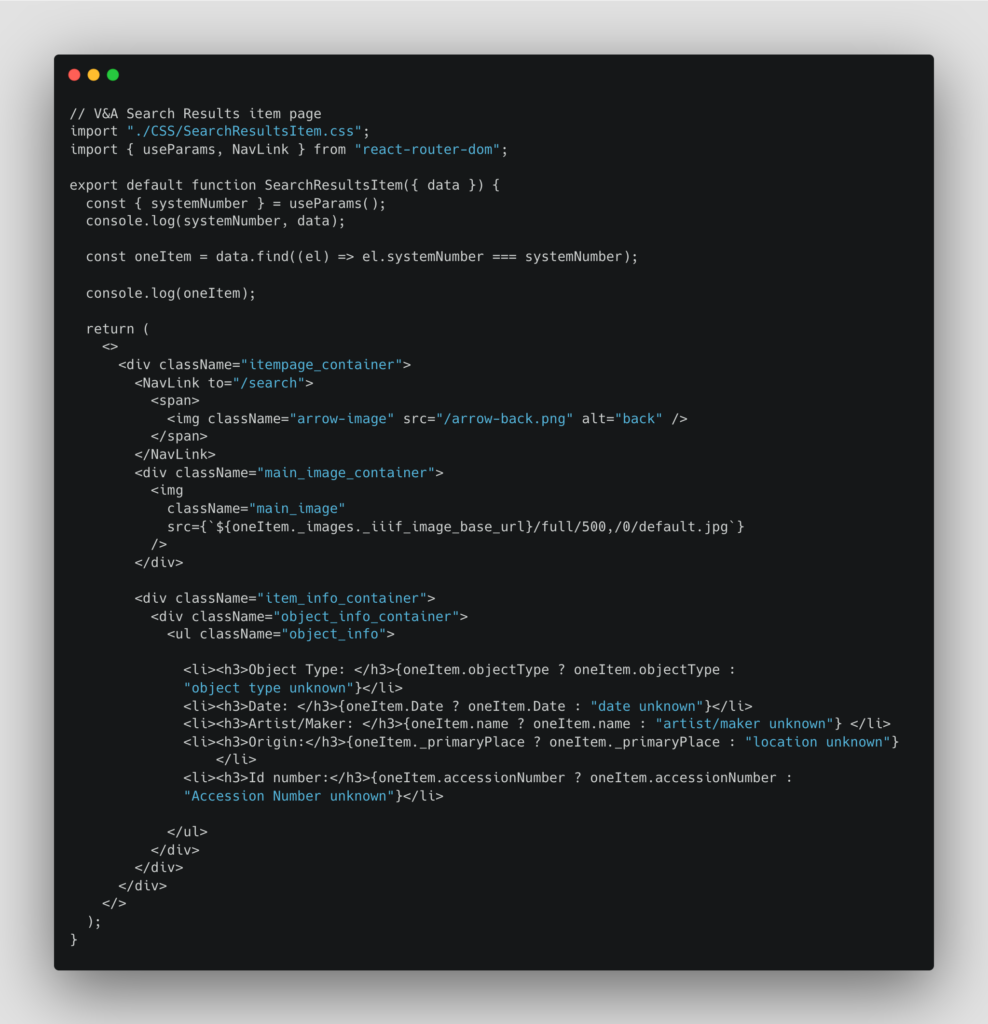
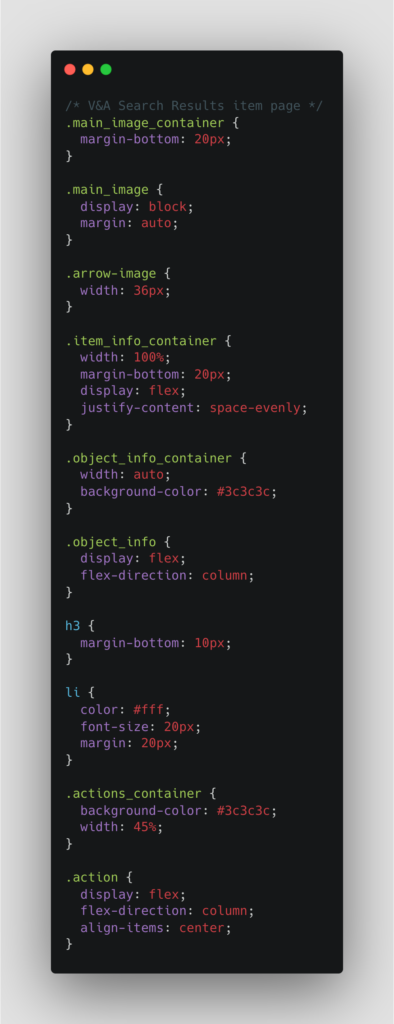
The individual item detail page — the core view of the application. useParams extracts the V&A system number from the URL, the matching object is found in the data, and the IIIF image URL is constructed inline to request a 500px-wide version of the museum photograph.
SearchResultsItem.jsx
SearchResultsItem.CSS
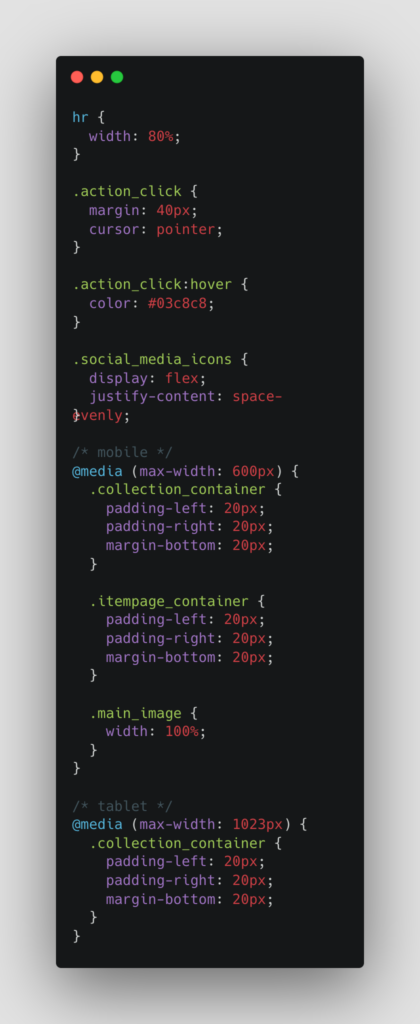
What This Shows
useParams extracts the V&A system number from the URL — each museum object is directly linkable without extra state management. The IIIF image URL is constructed inline using a template literal, requesting a standardised 500px-wide version of the museum photograph — a format I knew from working with museum digital collections in London. Every metadata field uses a ternary fallback, because V&A API data is incomplete for many historical objects. The CSS is component-scoped in a separate file, with mobile (600px) and tablet (1023px) breakpoints keeping the layout usable at all screen sizes.
Process & Practice
What I Learned
From Concept To Code
Taking a project from a real observed problem through wireframe design into a working React frontend gave me end-to-end experience of a product development cycle — the same process I had followed in apparel product development, now applied to software. The brief, the wireframes, and the final build are the same project at three different stages.
Working With Real Data
The V&A API returns inconsistently structured records for objects spanning centuries and cultures. Building defensive rendering with ternary fallbacks throughout became a discipline that carries directly into CMS work — content fields are often empty, and the interface needs to handle that gracefully rather than breaking.